Gunnerus Sustainability Award goes to pioneering researcher
Carl Folke, a groundbreaking researcher in his field, has been awarded the Gunnerus Sustainability Science Award for 2017.


Carl Folke, a groundbreaking researcher in his field, has been awarded the Gunnerus Sustainability Science Award for 2017.

The relationship children have with their parents can sometimes influence the relationship they have with their teachers. Now we know more about why.

When hydropower reservoirs traps organic matter, it leads to higher local greenhouse gas emissions. But the emissions are not increased but displaced. A new tool calculates the real greenhouse gas footprints of reservoirs.

Why do some sparrows hatch six chicks while others don’t hatch any? How does upbringing affect the remainder of their lives? Physiological stress in the nest can actually affect birds’ DNA and possibly their lifespan.

Did some of our human features evolve while our ancestors were living in water? The aquatic ape theory has been disregarded by paleoanthropologists, but it deserves another chance.

Bird songs have many functions, but their main purpose is to attract a mate. Some of the best avian singers are described below.

How do we protect astronauts in space from breathing dangerous gases? A German-Norwegian hi-tech optical gas sensor provides a solution.

Norwegian researchers are investigating how a snake robot might carry out maintenance work on the International Space Station (ISS), study comets, and explore the possibility of living and working in lava tunnels on the Moon.

Heavy-duty trucks will soon be driving around in Trondheim, Norway, fuelled by hydrogen created with solar power, and emitting only pure water vapour as “exhaust”. Not only will hydrogen technology revolutionize road transport, it will also enable ships and trains to run emission-free.
Norway has direct contact with the ISS space station. Now CIRiS – the Centre for Interdisciplinary Research in Space – is opening a new control room.

As a child, Professor Myrheim wondered what the far side of the Moon looked like. Trondheim’s Starmus festival will welcome a trio who has actually been on the moon, and the astrophysicist is excited to hear their lecture. “Perhaps it’s the magic of childhood that lingers on,” he says.

Just 12 Americans have set foot on the lunar surface, and of those, only six are still alive. Three—Buzz Aldrin, Charlie Duke and Harrison “Jack” Schmitt — will be in Trondheim at the Starmus Science Festival to talk about the future of humankind in space.

Science has made great strides since Svante Arrhenius, the Swedish Nobel Laureate who in 1896 first determined that carbon dioxide from human activity could warm the planet. The same progress hasn’t been made in increasing the number of women in the sciences.
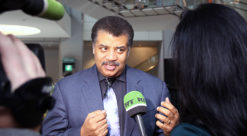
This year’s winners of the Stephen Hawking Medal for Science Communication 2017 were announced yesterday at a press conference in New York. The winner of the science communicator award is astrophysicist Neil deGrasse Tyson. The medal itself will be awarded on 20 June during the Starmus Science Festival in Trondheim.

Imagine a firefly fluttering near a floodlight. Can you see it? Not unless you shade the light coming from the glare of the lamp. This is where the sunflower screen enters the picture.

Whether you are religious or not does not matter so much. You regret one-night stands about as much as other people do.

Many of the speakers at the Starmus Festival are superstars in their fields of expertise. But few have as many fans as Brian Cox, the researcher who also feels at home in popular culture.

Imagine a dog owner with a reflective vest and a black dog without one. In the dark we can see how the dog owner moves, but not the dog. That’s how black holes work, too.

When you notice your partner is less interested than you are, your brain may send out a hormone that can help you fix the relationship.

He was the very first person to walk in space. A rescue team on skis brought him to safety after an emergency landing in the Siberian forest. Now, Alexei Leonov is coming to Trondheim.
Japanese researchers have access to the largest scientific vessel ever constructed, one that has a 120 metre tall derrick capable of drilling to 7500 metres below the seafloor. They’re using it to hunt for life deep under the seafloor and explore for mineral deposits at the bottom of the ocean — topics that are of great interest to Norwegian researchers.

How and why do movements of the Earth’s crust still cause death and destruction millions of years after they first happened? A new technique sheds light on this question.

What is the best form of first aid for a cold, injured body? Mountain medicine researchers are now co-operating to find the answer. At present there is actually no “best practice” for treating this type of patients.

Adolescents who are open to casual sex are more often involved in sexual harassment – both as victims and as perpetrators.

